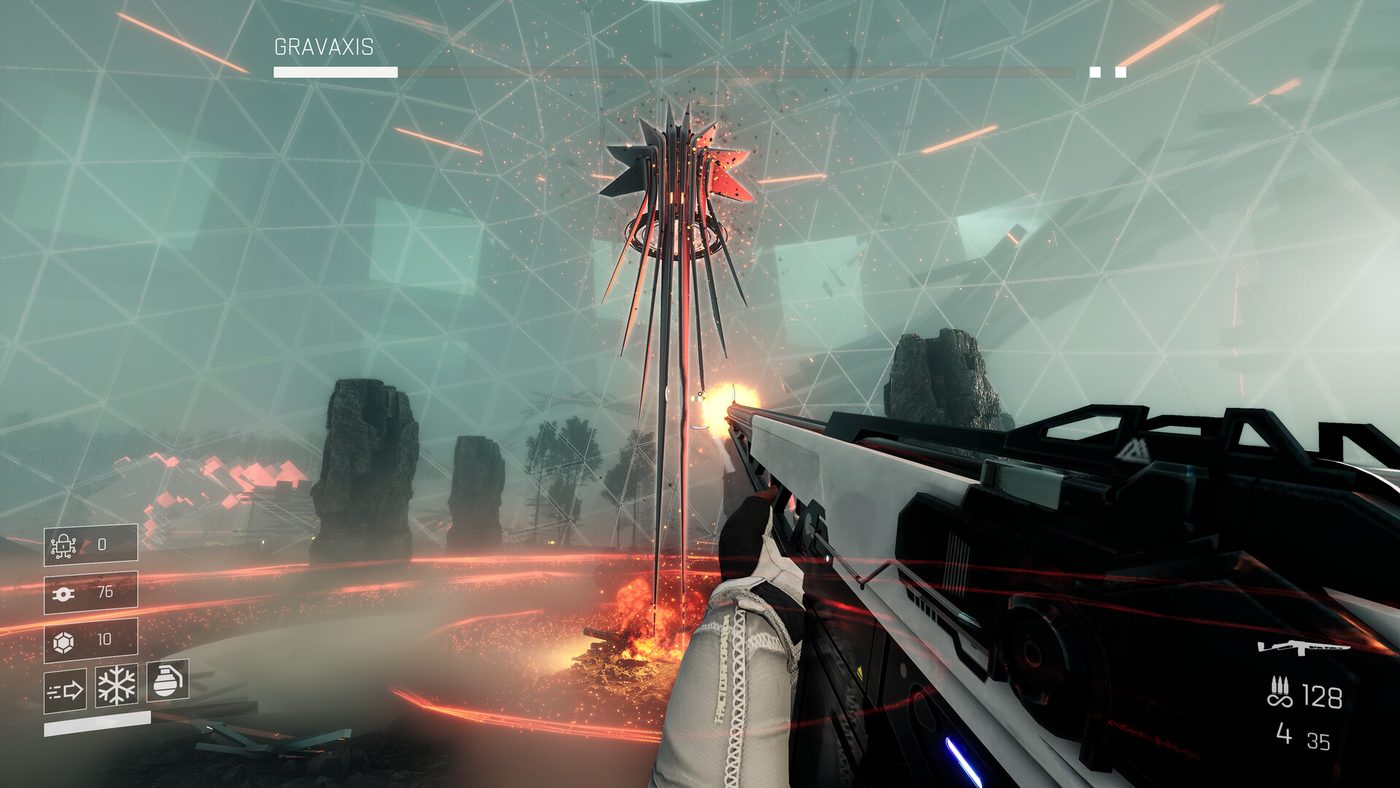
Gun modding system
Modules attach to weapon slots and change behaviour rather than raw damage. Slots are the constraint, invokers break the constraint, and rarity is not a power ladder — a Common slot invoker can outperform an Epic damage mod.
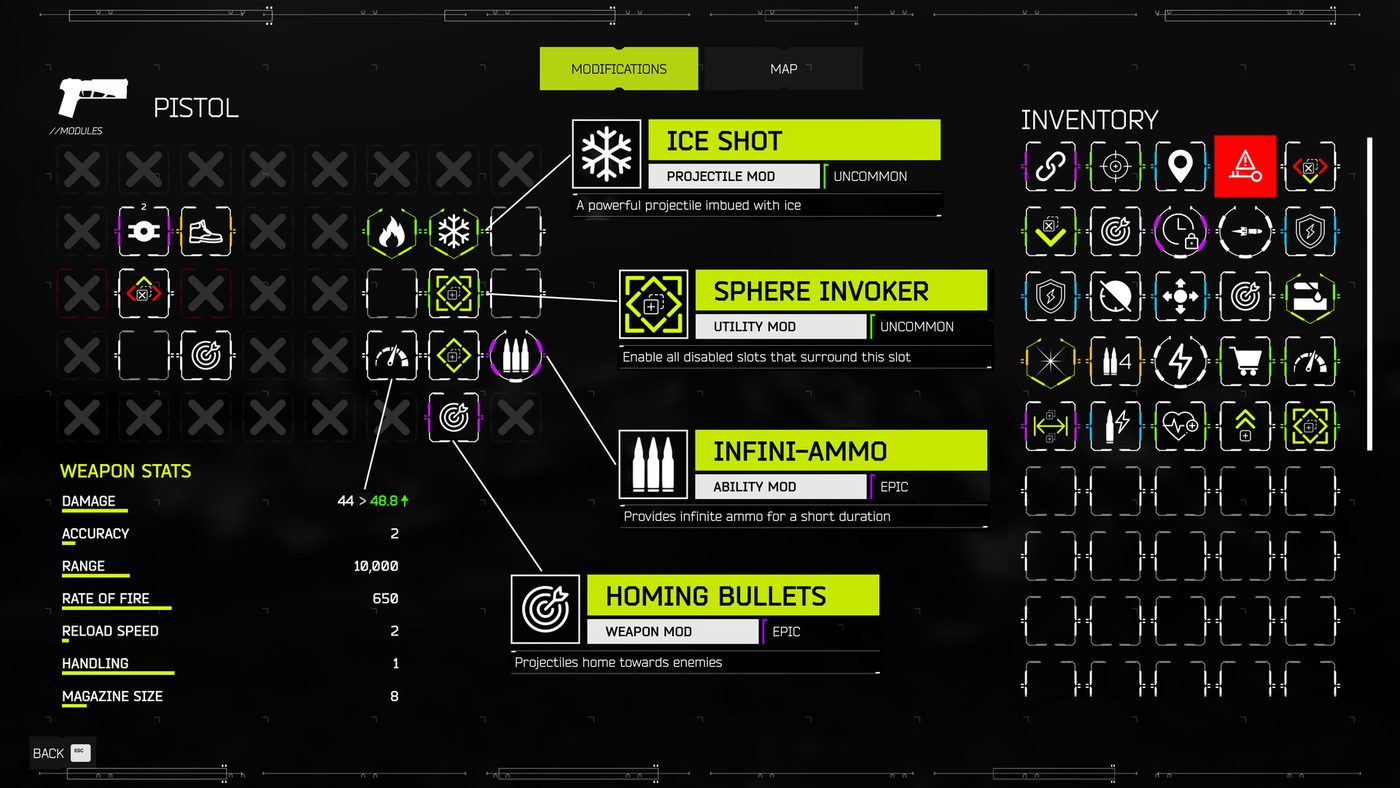
Gun modding is the reason VOID/BREAKER is not just a fast shooter. Every weapon has slots, every slot takes a module, and the modules change what the weapon does rather than how much damage it does. The store calls the result "infinite weapon variants", which is marketing, but the underlying claim holds up: the combinations are the content.
The modification screen
Open the modification screen and you get three things: the weapon on the left, a column of stat lines, and the module inventory on the right. The stat lines are fixed and identical across weapons.
| Stat line | What it governs |
|---|---|
| Damage | Per-shot damage before modifiers |
| Accuracy | Spread and how far the shot lands from the reticle |
| Range | Damage falloff distance |
| Rate of fire | Shots per second |
| Reload speed | Time to reload |
| Handling | How fast the weapon comes up and settles |
| Magazine size | Rounds before a reload |
Those seven lines are the whole language of weapon comparison. A chassis that trades handling for damage is a different weapon, not a reskin, and the trade shows up here before you ever fire it.
Module categories
Modules are grouped by what they attach to and what they do. The categories named in official material and on the modification screen:
| Category | What it changes | Examples from official notes |
|---|---|---|
| Weapon mod | The gun's firing behaviour or damage rules | High Caliber, Critical Wounds, Chain Reaction, Homing Bullets |
| Projectile mod | What the bullet does on hit | Ice Shot, and the elemental projectile family |
| Ability mod | Your abilities rather than the gun | Infini-Ammo, Nade Rage, Mine Fabricator, Throwing Knife |
| Utility mod | Slots, inventory and positioning | Sphere Invoker, Up Slot Invoker, Row Invoker |
| Melee mod | The cyber sword and its damage windows | Melee Reclaim, KNEE/BREAKER, Focused Strike, Serrated Edge |
| Fire mode mod | Adds or alters a firing mode | Pump Shot, and the per-weapon fire mode mods added in ASCENSION |
| Passive mod | Character-level effects | Zeus Strike, Cold Snap, Ice Breaker, Sharp Debris |
"Passive mod" was called "body mod" until the ASCENSION update renamed it across every instance in the game. If you are reading an older guide, that is the same category.
Rarity, and what it actually means
Modules carry a rarity label: Common, Uncommon, Epic, and Corrupted. Corrupted modules are the strange ones — they are powerful and they come with a condition, which is why one of the thirteen achievements is simply "Have at least 3 corrupted modules equipped at once".
Rarity is not a strict power ladder. A Common utility mod that opens slots can be worth more than an Epic damage mod, because slots are the resource that limits everything else. The RECALIBRATION patch notes even buffed Common slot invokers specifically: they now reach "in a 3 slot direction".
Slots and invokers
Slots are the constraint. Invokers are how you break the constraint. A slot invoker opens additional slots; a row invoker enables slots in a line; an up slot invoker "opens any slots in a two-slot vicinity upwards". Stack invokers and the weapon's capacity stops being a fixed number.
This is where the stacking rules matter. Modules do not all stack additively, and some effects are explicitly repeatable only through chassis mods. HARD RESET made weapon chassis mods visible in the modification screen "allowing some effects to be repeated" — which is the closest the game gets to telling you that duplicates are allowed in specific cases.
The recycler
Since RECALIBRATION, shops can host a Recycler that turns unwanted modules into credits. It only appears if you have the Recycler hack upgrade, and additional tiers of that upgrade improve the payout.
That single addition changes the module economy. Before it, a bad drop was dead weight in a limited inventory. After it, a bad drop is credits, which means taking a detour for a chest is rarely a wasted trip.
Practical stacking advice
Three rules cover most of it:
- Pick a damage engine first. Chain Reaction plus Repeater Effects is a self-contained engine: projectiles ricochet to the closest target, and the repeater effects increase the arcs. Everything else supports it.
- Then pick a survival rule. Cold Snap freezes everything when you take damage. Ice Breaker makes ice-inflicted enemies always take critical hits. Together they turn a mistake into an opening.
- Then fill with economy. Slot invokers and recyclers do not win fights, but they let you afford the modules that do.
The weapons overview covers the chassis side of the same system, and the builds page puts these combinations into full shells.
Where modules come from
Modules drop from chests, from mini-boss chests (which always provide a decryptor since RECALIBRATION), and from the supply crate hack, which no longer wastes a chest slot on ammo or health. Ability mods were made more likely to drop in the same update, which is why ability-heavy builds became practical afterwards.
Schematics are the other source. A schematic is a blueprint that, once researched at the hub, adds a module to the permanent loot pool. They are hidden in fragmented zones and points of interest, and since HARD RESET they come with a UI and audio cue when you are near one.
The mistake that costs the most runs
Treating the module column as a shopping list. Slots are the binding constraint, so the question is never "is this module good" but "is this module better than what is already in the slot, given what the rest of the build is doing".
A simple test before you equip anything: name the build in one sentence. If you cannot, the module is probably not the problem.
_Figures checked 4 November 2026 against the RECALIBRATION, ASCENSION and HARD RESET patch notes and the Steam store page._